Download PDF Capitalism without Capital: The Rise of the Intangible Economy, by Jonathan Haskel Stian Westlake
What kind of checking out publication are you searching for now? If you are truly keen on the subject just like Capitalism Without Capital: The Rise Of The Intangible Economy, By Jonathan Haskel Stian Westlake, you could take it straight right here. This book is actually a typical book. Yet, just how the writer get words to produce this book is so unbelievable. You may not find anything special from the cover and the title of guide, however you could obtain every little thing special from the book after read.
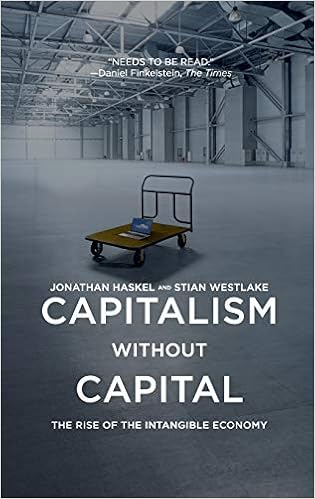
Capitalism without Capital: The Rise of the Intangible Economy, by Jonathan Haskel Stian Westlake

Download PDF Capitalism without Capital: The Rise of the Intangible Economy, by Jonathan Haskel Stian Westlake
Beloved readers, when you are hunting the new book collection to read this day, Capitalism Without Capital: The Rise Of The Intangible Economy, By Jonathan Haskel Stian Westlake can be your referred book. Yeah, even many books are supplied, this publication can steal the visitor heart so much. The material and also motif of this publication actually will touch your heart. You could locate increasingly more experience as well as understanding how the life is gone through.
It's needed now to own this publication by you. It is not as challenging as formerly to find a book. The contemporary technology always is the very best way to locate something. As here, we are the web site that constantly gives the book that you need. As Capitalism Without Capital: The Rise Of The Intangible Economy, By Jonathan Haskel Stian Westlake, we offer it in the soft file. You might not to publish it as well as get it as papers and also pilled individually. Reading this book in computer device or laptop can be likewise very same. In addition, you could also review it on your gizmo or Mobile phone. Currently, that's offered enough.
Are you still puzzled why should be this book? After having terrific task, you could not need something that is extremely hard. This is just what we state as the affordable publication to check out. It will not just provide enjoyment for you. It will offer life lesson behind the amusing features. From this instance, it is surely that this publication is appropriate for you and also for all people who need simple and also enjoyable book to read.
Thinking about guide Capitalism Without Capital: The Rise Of The Intangible Economy, By Jonathan Haskel Stian Westlake to review is additionally needed. You could select guide based upon the favourite themes that you like. It will engage you to like reviewing other publications Capitalism Without Capital: The Rise Of The Intangible Economy, By Jonathan Haskel Stian Westlake It can be additionally about the necessity that obligates you to check out the book. As this Capitalism Without Capital: The Rise Of The Intangible Economy, By Jonathan Haskel Stian Westlake, you can locate it as your reading publication, even your preferred reading book. So, discover your preferred book below as well as get the link to download the book soft data.
Review
"One of the Economist.com “Wise Words 2017 Books of the Year†in Economics and Business""One of Blackwell’s Best of Non-Fiction 2017""One of Financial Times (FT.com) Best Books of 2017: Economics""Selected for Askblog’s Books of the year 2017, chosen by Arnold Kling""The portion of the world's economy that doesn't fit the old model just keeps getting larger. That has major implications for everything from tax law to economic policy to which cities thrive and which cities fall behind, but in general, the rules that govern the economy haven’t kept up. This is one of the biggest trends in the global economy that isn’t getting enough attention. If you want to understand why this matters, the brilliant new book Capitalism Without Capital by Jonathan Haskel and Stian Westlake is about a good an explanation as I’ve seen."---Bill Gates, "The historical view of ‘capital as something tangible persists and limits our thinking,' the authors argue. To be sure, exactly which intangible assets qualify as capital can be debated endlessly. In Capitalism Without Capital, [they] choose a broad definition and explore its implications. In so doing, they provide insights into some puzzling questions . . . [and] make a good case that we don't know as much as we think because some of our tools for measuring economic performance are out of date."---George Molloan, Wall Street Journal"Economist Jonathan Haskel and UK government adviser Stian Westlake describe in an entertaining and engaging way why governments need to count innovation as an engine of profit."---Ehsan Masood, Nature"One of this year's most important and stimulating economic reads. . . . Read this book."---Tyler Cowen, Marginal Revolution"Recommended reading for venture capitalists and investment counselors." (Kirkus Reviews)"For an introduction, though, it would be hard to do better than Capitalism without Capital, which is clear and lively and raises--without having all the answers--the relevant questions."---Diane Coyle, The Enlightened Economist
Read more
From the Back Cover
"The nineteenth- and twentieth-century world where capitalists owned factories and workers supplied labor has ended. In this book, Haskel and Westlake explain with fascinating examples how business assets today are mostly intangible and how this changes everything we know about business—corporate strategy, accounting, leadership, and industrial strategy. Whether you are a customer, investor, manager, employee, or politician, you will gain new insights from this tour de force."--John Kay, author of Other People's Money"A must-read for anyone concerned about how to revive the growth of living standards."--Robert Peston, author of How Do We Fix This Mess?: The Economic Price of Having It All and the Route to Lasting Prosperity"On almost every page of this book I found myself going 'Oh, now I understand' or 'Yes, I never looked at it that way.' Capitalism without Capital is highly original and illuminating. It has changed the way I look at things."--Daniel Finkelstein, The Times columnist"This book shines a wonderful spotlight on the hidden capital that influences our world--measuring and understanding it is a top priority."--William R. Kerr, Harvard Business School"This fascinating book examines an important but overlooked subject—the intangible nature of capital and activity in the modern economy. The transformation of the intangible economy has rarely been pointed out, and its implications are not much understood or discussed. There are no other books similar to this one."--Diane Coyle, author of GDP: A Brief but Affectionate History"With an impressive breadth of topics, this thorough book takes a compelling look at the importance of intangible capital. Arguing that it offers an invaluable lens to view modern, dynamic innovative economies, the framework that Haskel and Westlake set forth is useful, insightful, and indispensable."--Carol Corrado, The Conference Board
Read more
See all Editorial Reviews
Product details
Hardcover: 288 pages
Publisher: Princeton University Press (November 28, 2017)
Language: English
ISBN-10: 0691175039
ISBN-13: 978-0691175034
Product Dimensions:
6.2 x 1 x 9.3 inches
Shipping Weight: 1.4 pounds (View shipping rates and policies)
Average Customer Review:
4.5 out of 5 stars
40 customer reviews
Amazon Best Sellers Rank:
#165,051 in Books (See Top 100 in Books)
Capitalism without Capital is an interesting book with very topical subject matter. Recent years has seen the brisk rise in market value of businesses defined by their network effects and operational leverage to the new economy rather than those dependent on traditional accounting defined forms of capital. In addition we have seen rising domestic Gini coefficients despite global improvements in aggregate output. Capitalism without Capital investigates the increased investment in intangible assets and their place in the modern economy. The authors propose that the increasing proportion of intangible investment can partially explain many of the economic issues that have been the center of attention of late and in addition need to be focused on more directly as we have so far not understood how to better capitalize and promote intangible investment as well as deal with various inequality effects that might come from them.Capitalism without Capital is split into two parts with the first titles - The Rise of the Intangible Economy. The author details how a simple business like a gym has morphed in how it adds value from a business which provided capital to one that effectively provides a coordinated service. This basic example serves to indicate that many modern businesses are increasingly defined by background coordination rather than provision of capital and this has required substantial amounts of intangible investment. The authors go through various accounting identities and show over the last 20 years how intangible capital investment has been growing and has closed in substantially on tangible forms of capital if not exceeded it. The authors describe how this evolution has occurred and geographically where it has occurred more, there is no doubt that it has been associated with the rise of technology as much intangible investments are aimed at improving coordination which is dependent on technology and communication systems to be in place. The authors then spend time on discussing the challenges of accounting for intangible investing and their return potential distributions are substantially wider than tangible investments. As a consequence capitalizing them is more challenging, a few quick conclusions though are that intangible investments can often be written off but they also have the ability to scale extremely well and have long lives. The authors give the example of how EMI effectively developed the CT scan but GE was able to capitalize on it for a low licensing fee. The authors give some foundational economic ideas about intangible investments and how they often lie in the realm of non-rival goods, an idea promoted by Paul Romer for what drives economic growth. The first section effectively lays the groundwork for how to think economically about intangible investment and how it differs from tangible investment and the trends of these categories.The authors get into their core ideas in the second part- The consequences of the Rise of Intangible Economy. In particular they start by discussing the potential role of intangible investing in secular stagnation and then move on to inequality. The post financial crisis led to concerns of secular stagnation where margins are high, investment is low alongside productivity growth. The authors argue that a world in which investment is taking place in the intangible form would display these characteristics. The arguments are reasonable but to a certain extent the arguments are also arguments of how intangible investments can lead to monopoly capital and the consequence of a world with increasing returns to scale and barriers to entry is facilitated by intangible investing, it seemed a bit odd to argue about the second order effects of secular stagnation rather than the first order (consolidation of industry, increased margins and worse labor/capital dynamics). The second focus, inequality of wages is a continuation of this though they bring up another important idea which is that if more of a business is defined by intangibles then this halo effect of ascribing shareholder value creation to the CEO is questionable. The authors do an ok job of describing how these phenomenon can be associated to the world in which intangible investment is what is driving value but the overall arguments are not at all definitive because they are very big topics. The authors also discuss how intangible investments require more equity and how policies that promote debt funding make it harder to invest in intangible despite them being currently demanded. The authors also discuss how business which use intangible investment vs create intangible investments might be structured differently, the former more authority based the latter more egalitarian. These sound superficially reasonable but I think some of what is discussed is vastly oversimplified. The authors then move to public policy and how to think about what we need to be navigating. The authors highlight some basic principles that distinguish what a good government from a bad with respect to intangible investing, highlighting things like tax, institutional arrangement, patent and IP laws to name a few. The broad principles are agreeable but the real challenge is the details. The author's also highlight how a government can fill a gap in basic research and build the foundation for businesses to further do R&D upon. The topic of how rights should be tied to ideas founded upon government R&D is not discussed, which I think is a shame.Capitalism without Capital is definitely worth reading as it gives a perspective on how many of the challenges we are facing might have aspects of intangible investments at their core. The authors are careful to highlight they do not have answers and that the problems we face are very complex but this book begins to frame some of the issues to think about. The authors touch upon many major ideas, the lack of borders on intangible investment and difficulty in taxing them, the need to create areas where people can coordinate but at same time not overdevelop them, the need to include government in supporting basic science research but have accountability. The list goes on- I definitely think the book is a good one to introduce some important concepts. There is no doubt that intangible investments will continue to drive benefits for some but create hindrances for others so it is time to start addressing them with better policy and accounting standards.
(From my 2017 Books in Review).This is the most exciting business book I have read in several year and I finished it in a day.Since I was in MBA school in the early 2000s, there have been a proliferation of books on the valuation of “intangible capital†which is historically and thinly recognized as “goodwill†in M&A transactions (as opposed to property and plant and inventory.) What Haskel and Westlake do here is to take this reality and project it forward for its widespread and often unforeseen effects on business and industry structure, sort of a Ronald Coates “Theory of the Firm†through the lens and pivot point of intangible capital. For Haskel and Westlake, intangible property and investments are just another chapter in a valuation textbook, but a different lens through which to view the economy and its industries.The book has a two minute overview on Youtube, here; see also multiple hour length interviews with the authors such as this one here. For a predecessor book that was a big influence on me in B-school in 2000, Hal Varian's "Information Rules," a classic from 1998.
Jonathan Haskel and Stian Westlake examine the rise of intangible assets within the developed economies and their impact on the society at large.Over the past decades, the nature of investment has been gradually shifting from tangible assets such as property, plant, and equipment to intangible assets, i.e. computerized information, innovative property, and economic competencies. In the United States, the amount invested in intangible assets has surpassed the sum invested in tangible assets since the mid-1990s. Messrs. Haskel and Westlake attribute this growth of intangible investments to factors such as the growing importance of service industries, globalization, and developments in IT and management technologies. Much of that shift does not come to the attention of the casual observer of financial statements and national accounts. If the intangible asset is not purchased outside the company, it will not be capitalized, but expensed. Perhaps, the asymmetric nature of the prevailing accounting rules on that subject should be revised sooner rather than later.Business readers will probably be most interested in the thorough examination of the four distinctive properties of intangibles investments. These investments are more likely to be scalable and have sunk costs. Furthermore, their benefits are more likely to spill over and exhibit synergies with other intangibles. This shift from tangible assets to intangible assets also has implications for management and financial investing. Messrs. Haskel and Westlake observe that a small number of large, dominant companies such as Google and Facebook not only excel in benefiting from their own investments, but also in appropriating the benefits of other firms’ investments. Similarly, investors who excel in becoming knowledgeable about the good and no-so-good intangible investments and about how best to deploy these good intangibles in businesses will outperform those who have not acquired this level of sophistication.Messrs. Haskel and Westlake also bring to the attention of their readers that these four distinctive features of intangible assets have a significant influence on the policy agenda of developed economies. First, both authors argue that the observed secular stagnation could also be due to both the unequal ability of companies in operationalizing intangible investments and the asymmetric nature of their prevailing accounting rules. Secondly, the unequal ability of companies and individuals to thrive in this metamorphosed investing environment contributes to a further exacerbation of the existing income inequality. Thirdly, the essence of intangible assets requires a different financial architecture than the existing one that is designed for the needs of tangible investments. For example, equity financing should be systematically considered beside debt financing. Finally, this shift requires a higher need for IT infrastructure and affordable living in large cities as well as a rethinking of the norms, standards, and rules that govern both the collaboration and interaction among companies, individuals, and government.In summary, Messrs. Haskel and Westlake make a compelling case that both the society and economy of developed countries have to adapt to this shift for achieving higher prosperity.
Capitalism without Capital: The Rise of the Intangible Economy, by Jonathan Haskel Stian Westlake PDF
Capitalism without Capital: The Rise of the Intangible Economy, by Jonathan Haskel Stian Westlake EPub
Capitalism without Capital: The Rise of the Intangible Economy, by Jonathan Haskel Stian Westlake Doc
Capitalism without Capital: The Rise of the Intangible Economy, by Jonathan Haskel Stian Westlake iBooks
Capitalism without Capital: The Rise of the Intangible Economy, by Jonathan Haskel Stian Westlake rtf
Capitalism without Capital: The Rise of the Intangible Economy, by Jonathan Haskel Stian Westlake Mobipocket
Capitalism without Capital: The Rise of the Intangible Economy, by Jonathan Haskel Stian Westlake Kindle
