Download Ebook The Ultimate Star Trek and Philosophy: The Search for Socrates (The Blackwell Philosophy and Pop Culture Series)
Compared to other individuals, when a person constantly aims to set aside the time for reading, it will give finest. The result of you read The Ultimate Star Trek And Philosophy: The Search For Socrates (The Blackwell Philosophy And Pop Culture Series) today will affect the day thought and also future ideas. It means that whatever obtained from reading book will certainly be long last time financial investment. You could not need to obtain experience in real condition that will certainly spend more money, yet you can take the method of reading. You can additionally discover the genuine point by checking out book.
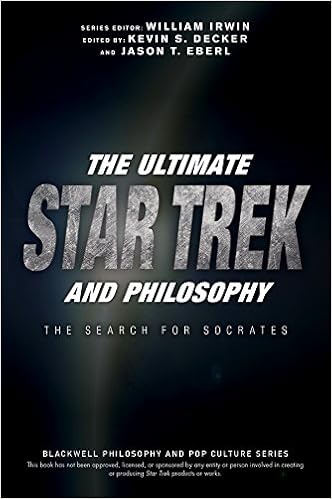
The Ultimate Star Trek and Philosophy: The Search for Socrates (The Blackwell Philosophy and Pop Culture Series)

Download Ebook The Ultimate Star Trek and Philosophy: The Search for Socrates (The Blackwell Philosophy and Pop Culture Series)
Think about a great publication, we remind concerning The Ultimate Star Trek And Philosophy: The Search For Socrates (The Blackwell Philosophy And Pop Culture Series) This is not a new most current book, but this book is always bearing in mind at all times. Many individuals are so pleasant for this, authored by a renowned writer. When you want to buy this advantage in some stores, you could not find it. Yeah, it's limited currently, possibly or it is constantly sold out. Yet right here, no stress over it! You can get it any time you want and every where you are.
Reading a book is also type of far better option when you have no sufficient money or time to get your very own experience. This is among the reasons we show the The Ultimate Star Trek And Philosophy: The Search For Socrates (The Blackwell Philosophy And Pop Culture Series) as your close friend in investing the moment. For more depictive collections, this book not only supplies it's strategically book resource. It can be a friend, great friend with much expertise.
Yeah, soft file ends up being a reason that you need to read this book. If you bring the published publication for some places, it will make your bag to be much heavier. When you could stick with the soft documents, it will not have to bring hefty thing. Nonetheless, the The Ultimate Star Trek And Philosophy: The Search For Socrates (The Blackwell Philosophy And Pop Culture Series) in soft data can be a choice when you opt for some locations or remain at house. Please read this book. It is not only the suggestion; it will be motivations for you and also you're your life to progress better.
However, also this book is produced based upon the fact, one that is really fascinating is that the author is extremely clever to earn this publication easy to check out and understand. Valuing the great visitors to always have checking out behavior, every author offers their finest in supplying their thoughts and also jobs. That you are and also what you are doesn't end up being any kind of huge trouble to get this publication. After visiting this website, you can check more about this book and then discover it to realize analysis.
From the Back Cover
Can a starship captain be both great and moral? Can Vulcans and androids really have (or be) friends? What is it like to be a hologram, shapeshifter, or incorporeal entity? Why do the Borg frighten us so much? Is there room for God in the Star Trek universe? Is Q just a sadistic pest or a provocateur of human advancement? The Ultimate Star Trek and Philosophy boldly goes where no book has gone before in pursuit of a greater philosophical understanding of the galaxy’s final frontier. It reunites the editors of Star Trek and Philosophy with Starfleet’s finest experts for 30 new, highly logical essays to provide a thorough examination of the Star Trek universe - from the original series to the most recent films directed by J.J. Abrams, Star Trek (2009) and Star Trek Into Darkness (2013). The essays introduce important concepts in philosophy through the vast array of provocative issues raised by the series, such as the ethics of the Prime Directive, Star Trek’s philosophy of peace, Data and Voyager’s Doctor as persons, moral relativism and the Federation’s quest for liberation, the effect of alternate universes on reality and identity, the Borg as transhumanists, Federation Trekonomics, and Star Trek’s secular society. Available in time to celebrate the 50th anniversary of the endlessly inventive and beloved Star Trek franchise, this is an enterprising and enlightening voyage into deep space that will appeal to hardcore fans and science fiction enthusiasts alike.
Read more
About the Author
Kevin S. Decker is Professor of Philosophy at Eastern Washington University, where he teaches ethics, American and Continental philosophy, and philosophy of popular culture. He is co-editor of Philosophy and Breaking Bad (2016) and Who is Who? The Philosophy of Doctor Who (2013). He is co-editor, with Jason T. Eberl, of The Ultimate Star Wars and Philosophy (Wiley-Blackwell, 2015), Star Trek and Philosophy (2008), and Star Wars and Philosophy (2005).Jason T. Eberlis the Semler Endowed Chair for Medical Ethics and Professor of Philosophy at Marian University in Indianapolis, Indiana, where he teaches bioethics, ethics, and medieval philosophy. He has edited or contributed to books on Battlestar Galactica, Sons of Anarchy, Metallica, Terminator, The Hunger Games, The Big Lebowski, Stanley Kubrick, J.J. Abrams, and Avatar. His most recent books are The Routledge Guidebook to Aquinas’ Summa Theologiae (2015) and The Philosophy of Christopher Nolan (2016). He is co-editor, with Kevin S. Decker, of The Ultimate Star Wars and Philosophy (Wiley-Blackwell, 2015), Star Trek and Philosophy (2008), and Star Wars and Philosophy (2005).
Read more
Product details
Series: The Blackwell Philosophy and Pop Culture Series (Book 1)
Paperback: 368 pages
Publisher: Wiley-Blackwell; 1 edition (April 4, 2016)
Language: English
ISBN-10: 1119146003
ISBN-13: 978-1119146001
Product Dimensions:
5.8 x 0.8 x 8.8 inches
Shipping Weight: 1.1 pounds (View shipping rates and policies)
Average Customer Review:
4.2 out of 5 stars
11 customer reviews
Amazon Best Sellers Rank:
#250,202 in Books (See Top 100 in Books)
Wife loves Star Trek. Bought it for her. She love it.
Brilliant!
The book was in excellent condition when it arrived. The ideas and theme of the book was enjoyed by the person who received it.
I teach a course called Ethics of the Future: Analysing Science Fiction Films at Kyung Hee University in South Korea, and the class focuses exclusively on Star Trek TOS. I use several chapters from this book in my class concerning the Star Trek Philosophy of Peace and the chapter on Kirk destroying utopias, as in This Side of Paradise and The Apple. I like the fact that this book contains references to the animated series, but am far less enthusiastic about the materials concerning the awful reboots that started in 2009, hence I can only give it four stars instead of five. If you love real Star Trek and want a guide to the philosophical issues in it, this is your book. Live long and prosper. Roger Thompson MA FRAS FRSA, Assistant Professor, Kyung Hee University, Korea.
Star Trek has always been about making the audience think. Episodes like "Let That Be Your Last Battlefield" tackled racial prejudice in a way that wouldn't have been possible on mainstream television in the 1960s, and the Deep Space Nine episode "In the Pale Moonlight" challenged Sisko to decide whether the cost of his ideals and two lives was worth potentially saving the lives of millions in a galactic war. In that spirit, "The Ultimate Star Trek and Philosophy" looks at questions of morality, the soul, existence an more through the lens of science fiction. Examples come from the original series through the J.J. Abrams films, so whether you're a Kirk, Picard or Janeway fan, there will be something for you. The essays are about ten pages in length each, making this a good book to own on your Kindle for reading on the train, a plane or vacation.
Since most Star Trek fans are at lease armchair philosophers, this book might be a good read for them. For others, not so much.The book is a collection of essays on various themes (check the table of contents with the "Look Inside" feature on Amazon). Each chapter is written by a different author, but there are some characteristics that they have in common. Every chapter presumes a deep knowledge of most episodes from every series. The book is consistent in using TOS and TNG, for example, to mean The Original Series and The Next Generation. But TAS? It means The Animated Series of which I have only seen one episode and hated it. So I don't get the often references to events from that series.The topics covered by each chapter are quite esoteric. This is definitely not for high school kids no matter how much Star Trek they have watched. The question isn't, "Is Data human?" (of course he isn't), the question is, "Does Data have personhood?" which is introduced with typical philosopher tongue-in-cheek, "Why Data is Not a Toaster." Cute title,but an academic explanation requiring much college-level coursework to comprehend. And don't forget you need to remember the episodes to get the illustrative examples.The layout is that of an academic book, though the paper texture is somewhat closer to newspaper (hard to describe).I minored in philosophy and enjoy(ed) reading many academic philosophy journals. I loved all incarnations of Star Trek (except TAS). But this book just didn't do much for me. Were the examples (of which I remembered most) just boring? Was it that the authors were just commenting on something that I didn't care about? I'm not sure. These authors would not be good TED speakers.
I enjoyed reading this book. Star Trek, as a science fiction theme lends itself very well to incorporating philosophical themes and adds an element of familiarity to the fan who recognizes the dramatic themes and how they illustrate the philosophical concepts.This read was enjoyable and it furthered my appreciation and understanding of philosophy by tying it into some of my favorite shows.
The Ultimate Star Trek and Philosophy: The Search for Socrates (The Blackwell Philosophy and Pop Culture Series) PDF
The Ultimate Star Trek and Philosophy: The Search for Socrates (The Blackwell Philosophy and Pop Culture Series) EPub
The Ultimate Star Trek and Philosophy: The Search for Socrates (The Blackwell Philosophy and Pop Culture Series) Doc
The Ultimate Star Trek and Philosophy: The Search for Socrates (The Blackwell Philosophy and Pop Culture Series) iBooks
The Ultimate Star Trek and Philosophy: The Search for Socrates (The Blackwell Philosophy and Pop Culture Series) rtf
The Ultimate Star Trek and Philosophy: The Search for Socrates (The Blackwell Philosophy and Pop Culture Series) Mobipocket
The Ultimate Star Trek and Philosophy: The Search for Socrates (The Blackwell Philosophy and Pop Culture Series) Kindle
